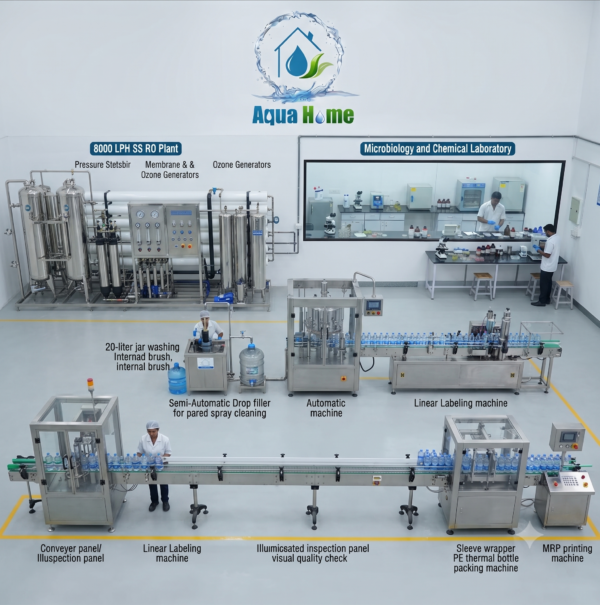
AH 8000 LPH ISI PACKAGED DRINKING WATER PLANT UNIT FULL SETUP
An 8,000 Liters Per Hour (LPH) ISI-certified packaged drinking water plant is a heavy-duty, high-capacity commercial setup. It generally supports a rinsing, filling, and capping output of around 120 bottles per minute (BPM) or roughly 6,000 to 7,200 bottles per hour for 1-liter bottles.
Estimated equipment and machinery costs for a fully automatic setup typically range from ₹50 Lakhs to ₹1.5 Crores+, depending on the level of automation, specific brand components, and auxiliary packaging gear
1. Raw Water & Pre-Treatment Specifications
• Raw Water Pump: High-capacity stainless steel centrifugal pump (SS 304/316) for feeding raw water from a borewell or municipal source.
• Multi-Grade Filter (MGF): Quartz sand and pebble media to remove suspended solids, turbidity, and physical impurities.
• Activated Carbon Filter (ACF): Granular Activated Carbon (GAC) to absorb chlorine, organic compounds, bad odors, and color.
• Iron Removal Filter (If required): Specialized media if raw water has high ferrous iron content.
• Dosing Systems: Antiscalant dosing system to prevent RO membrane scaling, and raw water chlorination/dechlorination setup.
2. Purification & RO System Specifications
• Reverse Osmosis (RO) Plant: Dual-pass or high-recovery RO system rated for 8,000+ LPH capacity to account for reject water (recovery typically 50–60%).
• Membranes & Housings: High-rejection composite polyamide membranes (e.g., Hydranautics or Dow/Filmtec) with SS pressure tubes.
• High-Pressure Pumps: Multi-stage vertical centrifugal pumps (e.g., Grundfos or equivalent) for RO feed.
• UV Sterilization System: Ultraviolet disinfection chambers post-RO to neutralize residual bacteria.
• Ozonation System: Ozone generator with mixing pump and contact tank to infuse ozone into treated water, ensuring shelf-life sterility required by BIS/ISI standards.
• Remineralization System: Automatic mineral dosing/adjustment system to re-add precise quantities of essential minerals (magnesium, calcium) to meet BIS drinking water norms (IS 14543).
3. Filling & Packaging Line Specifications
• Automatic Rinsing-Filling-Capping Machine (Monoblock): Rotary or linear automatic rinsing, gravity/pressure filling, and screw capping machine (Speed: ~120 BPM for 500ml/1000ml PET bottles).
• Material of Construction (MOC): Food-grade Stainless Steel (SS 304 for body frames and contact parts; SS 316 for critical liquid paths).
• PET Bottle Blowing Machine: Semi-automatic or fully automatic stretch blow molding machine with air compressor and high-pressure boosters (to manufacture bottles on-site).
• Conveyor Systems: Air conveyors for empty bottles and flat-chain stainless steel/PVC conveyors for filled bottles.
• Batch Coding / Printing: Inkjet or laser coding machine for manufacturing date, MRP, and batch numbers.
• Labelaling & Packaging: Automatic sleeve/sticker labeling machine and shrink-wrapping machine for bundle packaging. [1, 2]
4. Utility & Quality Control Lab (Mandatory for ISI/BIS Certification)
• Power Requirement: Approximately 90 kW to 150 kW (3-phase, 415V electrical supply) depending on whether an in-house PET blow molding machine is included.
• In-House Quality Laboratory: Mandatory testing instruments for BIS compliance, including pH meter, TDS meter, incubator for microbiological testing, turbidity meter, colony counter, and chemical titration kits.
• Space Requirement: Minimum 4,000 to 6,000 sq. ft. covered industrial shed separated into raw water area, processing/filling clean room, microbiological lab, and storage zone.
You may also like
AH 20000 LPH ISI PACKAGED DRINKING WATER PLANT UNIT FULL SETUP
AH 12000 LPH ISI PACKAGED DRINKING WATER PLANT UNIT FULL SETUP
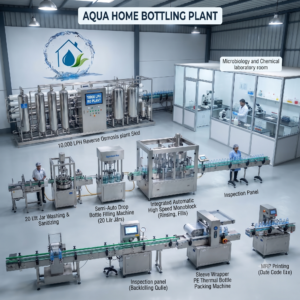
AH 10000 LPH ISI PACKAGED DRINKING WATER PLANT UNIT FULL SETUP
Reviews
There are no reviews yet.