AH 6000 LPH ISI PACKAGED DRINKING WATER PLANT UNIT FULL SETUP
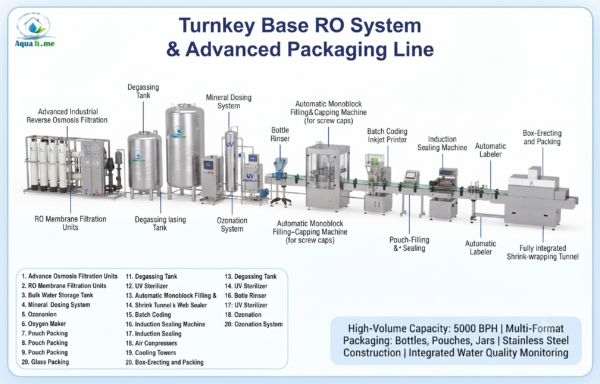
A full-setup 6,000 LPH (Liters Per Hour) ISI-compliant packaged drinking water plant is an industrial-grade, end-to-end processing and bottling line designed to meet Bureau of Indian Standards (BIS) norms under IS 14543.
Here is the complete breakdown of the technical specifications, purification stages, bottling machinery, and compliance requirements for a 6,000 LPH setup.
1. Raw Water Pre-Treatment System
Before water reaches the high-pressure purification stages, it goes through heavy-duty filtration to remove suspended solids, turbidity, and foul odors.
• Raw Water Feed Pump: SS-304 centrifugal pump to draw water from source/storage.
• Multi-Grade Sand Filter (MSF): Removes suspended particles, dust, and turbidity using graded quartz sand and pebbles.
• Activated Carbon Filter (ACF): Eliminates free chlorine, organic compounds, color, and bad odors/tastes.
• Antiscalant Dosing System: Automatically injects antiscalant chemicals to prevent scaling on the reverse osmosis membranes.
• Micron Bag/Cartridge Filter (5-micron): Acts as a final guard before the RO system to catch fine particles.
2. Reverse Osmosis (RO) Purification System
• Capacity: True output of 6,000 liters/hour of permeate water (factoring in recovery rates).
• High-Pressure Pump (HPP): Multi-stage vertical centrifugal pump (e.g., Grundfos or equivalent high-grade SS) to drive water through membranes.
• RO Membranes: High-rejection composite polyamide thin-film membranes (typically 4-inch or 8-inch array configuration) to reduce total dissolved solids (TDS) by up to 95-98%.
• SS Pressure Tubes / Skid: Mirror-finished Stainless Steel (SS-304 or SS-316 grade) skids and housings.
3. Mineral Addition, Post-Treatment & Disinfection
Packaged drinking water requires precise mineral balancing and sterile storage.
• TDS Adjuster / Blending System: Blends a controlled portion of micron-filtered raw/treated water to reach the desired mineral/TDS taste profile.
• pH Booster / Dosing: Adjusts the pH level to meet neutral/alkaline standards (~7.0 to 8.5).
• Ultraviolet (UV) System: High-intensity UV sterilization chamber to neutralize remaining bacteria and micro-organisms.
• Ozonator Unit: Injects ozone (O₃) gas into the treated water stream right before filling to ensure a residual disinfecting effect inside sealed bottles.
• Pure Water Storage Tank: Food-grade SS-304/SS-316 storage tanks (capacity ranging between 2,000 to 5,000 liters).
• Final Micron Cartridge Filter (0.2 Micron): Polishing filter placed right before the rinsing/filling machines.
4. Rinsing, Filling, and Packaging (R.F.C.) Line
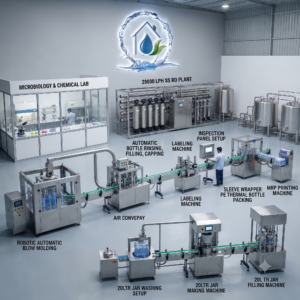
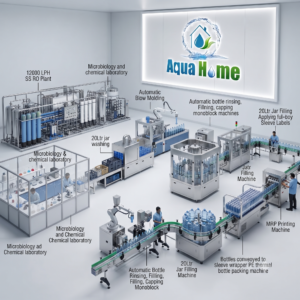
• Rinsing-Filling-Capping Machine: Automatic or semi-automatic rotary/linear monoblock setup suited for PET bottles (200ml to 2 Liters) or 20-Liter jar washing/filling stations depending on your target market.
• Bottle Output Capacity: Typically synchronizes with 40 to 60 bottles per minute (BPM) for standard lines.
• Batch Coding / Date Printing: Inkjet coder for printing MRP, manufacturing date, and batch number.
• Tunnel Wrapper / Packing Machine: Shrink-wrap packaging system for bundling finished bottles.
5. Quality Control Laboratory (Mandatory for ISI)
To obtain and maintain a BIS/ISI license, an on-site testing laboratory is mandatory. It must include:
• Microbiological Lab Setup: Incubators, colony counters, and laminar air flow benches for testing coliform and E. coli.
• Chemical Testing Equipment: Digital pH meter, TDS/conductivity meter, turbidity meter, and glassware/reagents for chemical titration tests.
________________________________________
Key Operational Parameters
• Material of Construction: All fluid-contact parts, vessels, and skids are built with SS-304 (or upgraded SS-316 for pharmaceutical/corrosive water standards).
• Power Requirement: Approximately 35 kW to 85 kW three-phase connected load depending on the level of automation and whether bottle-blowing machines are integrated.
• Certifications Needed: BIS certification under IS 14543 (Packaged Drinking Water), FSSAI central license, and State Pollution Control Board (NOC).
If you like to know more let us know:
• Your source water quality / raw TDS level
• Whether you are targeting small PET bottles (200ml–2L) or 20L water cans/jars
we can help estimate the total power requirements, space dimensions, or project budget.
You may also like
AH 2000 LPH ISI PACKAGED DRINKING WATER PLANT UNIT FULL SETUP
AH 10000 LPH ISI PACKAGED DRINKING WATER PLANT UNIT FULL SETUP
AH 20000 LPH ISI PACKAGED DRINKING WATER PLANT UNIT FULL SETUP
Reviews
There are no reviews yet.